



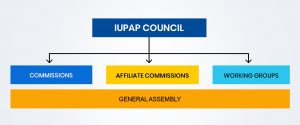
The Union is governed by its General Assembly which meets every year. In person assemblies take place triennially, the rest of the years the assembly meets online or in hybrid mode. The Executive Council is its top executive body, supervising the activities of its specialized International Commissions, Affiliated Commissions and of its Working Groups. The number of Working Groups is highly variable. They are created for a limited time period to address specific issues or problems and are dissolved once they have completed their tasks.
According to the new Articles approved by the 30th General Assembly in October 2021, the IUPAP now has three types of members:
- “Territorial Members”. They are entities representing communities of physicists engaged in independent scientific activity each within a definite territory and listed under a name that avoids any misunderstanding about the territory represented. The word “territory” does not imply any political position on the part of IUPAP, which seeks to assist physicists everywhere in carrying out its mission. These members have voting rights at the General Assemblies and pay membership dues. There are 18 categories of territorial members, depending on the number of due duties that they pay. The number of votes they have at the General Assembly, in turn, depends on the category.
- “Personal Members” Ex-Officio. They are only the Chairs of IUPAP Commissions or Affiliated Commissions. They have voting rights (one vote per person) but are exempted from paying membership dues.
- “Corporate Associate Members”. They are commercial companies or international research organizations that have a special relationship with the field of physics or scientific research. These members do not have voting rights but can participate in the General Assembly through their official Delegates and they pay membership dues (a number of due units that is negotiated with the Executive Council). They are entitled to make nominations for any position depending on the number of due units that they pay.
